Also called "Life on" because their functions are:
This system is called also "autonomous." Is related to the viscera, glands, heart , blood vessels and lisos.Su muscles is efferent function, transmitting impulses that regulate the functions of the organs in accordance with the vital requirements of the moment.
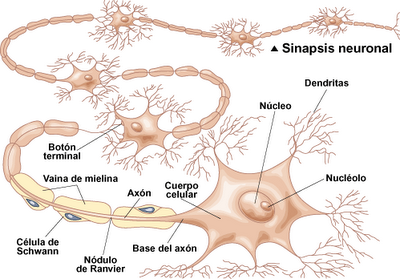
The neuron cell is nervous neuroblasto.Es derived from the functional unit of the nervous system provides a link for communicating between receptors and effectors, through nerve fibers.
consists of three parts:
body or soma, composed mainly of nucleus, cytoplasm and nucleolus.
Dendrites: nerve endings.
Axon: long ending, which can reach up to one meter in length.The axon usually has multiple endings called terminal buttons, which are in proximity to the dendrites or in the body of another neuron .
The separation between the axon of one neuron and the dendrites or the body of another, is of the order of 0.02 micras.Esta relationship between the axon of one neuron and the dendrites of another is called "synapses ".
Through synapses, a neuron sends a message pulses from axon to dendrites or other body, and transmitting information nerviosa.La synaptic transmission has the following character istics: The nerve impulse conduction takes place in one sense: the axon of a neuron body or dendrites of another neuron synapse. The nerve impulse is propagated through chemical intermediates, such as acetylcholine and norepinephrine, which are released by the axon terminals of the first neuron and are received by the following prompt in it the production of a new momentum. In the central nervous system neurons, excitatory and inhibitory and each substance releases its own mediator. The speed impulse conduction along nerve fibers varies from 1 to 100 meters per second, according to their size, being higher in the longest. When the presynaptic terminals are stimulated continuously or in high frequency, transmitted pulses decreased in number because of a "synaptic fatigue." The transmission of a signal from one neuron to another suffers a delay of 5 milliseconds.
The neuroglia. The central nervous system man is about 10 billion neurons and 5 to 10 times more glial cells.
These cells form a tissue called glia that has the following duties: Provide support to the brain and spinal cord. Skirting the blood vessels forming an impenetrable barrier to toxins. Neurons provide vital chemicals. Removed by phagocytosis, the dead tissue. Insulate axons through the myelin.
4. The nerves are nerviosLos usually do or sets of axons, but the sensory nerves which are composed of functional dendrites long ranging from the "boom" of the spinal cord to the sensory receptors and their function of conducting impulses as axons. The various nerve fibers forming a unity maintained by connective tissue. The nerves can be classified in several ways: By origin: spinal: Composed of nerve fibers of the anterior roots and motor and sensory or posterior roots, which leave the bone through the foramina. The spinal nerves are visceral and somáticosLos visceral elements are related to structures surrounding the digestive, respiratory, urogenital and vascular system and most of the glands.
somata are related to the coating body tissues and voluntary muscles. 
Skull: There are 12 pairs of nerves that arise from the brainstem at the level of the fourth ventricle, above the medulla and serve mostly to specialized senses of the face and head. Its performance is mixed, ie, it contains sensory and motor fibers.
Among the cranial nerves are: the olfactory, the optic, which joins the central nervous system to the thalamus, the oculomotor, the trochlear or pathetic, the abducens, the trigeminal nerve fibers sensory temperature, pain, touch and pressure , the facial, the ramjet-acoustic; and acoustic receivers position and movements of the head, the glossopharyngeal, vagus and the spinal accessory halibut.
By function:
Sensory or afferent
:
conduct impulses that inform the various sensations.
motors or efferent:
conduct impulses to motor functions.
Mixed: fibers contain sensory and motor fibers.
For collectors: exteroceptive: For pulses produced by outside stimuli body: touch, temperature , pain, pressure , and sensory organs like the eye and ear .
proprioceptive
: For stimuli born in the same body: muscles, tendons, joints and related balance. Interoceptive: For the impulses from the viscera: digestive system, respiratory, circulatory, urogenital and glands.
5. The spinal cord 
The spinal cord is a cylindrical mass of nerve tissue that occupies the spinal canal is 40 to 45 cm in length and extends from the foramen magnum, which is continuous with the medulla to the lumbar region.
is protected by the meningeal membranes, pia, arachnoid and dura mater and cerebrospinal fluid.
From the region of the second lumbar vertebra, where the bone ends, to rump, down a filament delgadollamado "filum terminale" and sacral nerve roots and lumbar vertebrae, forming a bundle of fibers called "tail horse. "
From out 31 pairs of spinal nerves that give it a segmented: 8 cervical, 12 thoracic, 5 lumbar, 5 sacral, and coccygeal.
Bone consists of a gray matter consists of cell bodies, and white matter consists of myelinated fibers ascending and descending.
ascending fibers are ascending beams that are sensitive and conduct impulses they receive from skin, muscles and joints to different brain areas.
descending fibers are descending beams are engines and conduct impulses from higher centers of the brain others who reside in the bone or the muscles and glands.
The gray matter has a widening called "horns", two gift dorsal or later, two ventral and two intermediate or above and are located between the dorsal and ventral. The dorsal horns contain neurons that control motor responses of the autonomic nervous system and the ventral motor neurons whose axons end in the muscles of the somatic system.
In the center of the gray matter and along it there is a small fluid-filled canal cefalorraquídeo.Otro important aspect of the spinal anatomy, is that there are neurons which connect between the sensory and motor fibers, which gives rise reflex responses that need not be ordered by the brain centers.
The functions of a bone are
center is a partnership, through which are made reflexes.
is a two-way direction :
from the periphery to the brain centers (sensitive).
From brain centers to the periphery (motor).
6. The brain
The brain is the central nervous system enclosed in the cranial cavity.
is divided into:
Forebrain.
midbrain. Brain
later.
The brain or rhombencephalon posterior is located in the part immediately above the spinal cord and consists of three structures : the medulla, pons or bridge, and the cerebellum. It is also the fourth ventricle.
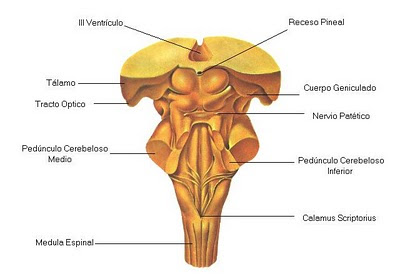
The forebrain or prosencephalon is divided into diencephalon and telencephalon.
The diencephalon comprises: the thalamus, hypothalamus, optic chiasm, the pituitary, the mamillary bodies and the cavity called the third ventricle.
the telencephalon consists of the basal ganglia: caudate and lenticular nuclei that form the corpus striatum and the amygdaloid body and faculty, the rhinencephalon, hippocampus and septal area, which form the limbic system, and the cerebral cortex or neocortex . The enlargement of the telencephalon
form the cerebral hemispheres consisting of three lobes: frontal, temporal and occipital lobes. Externamente los hemisferios tienen múltiples pliegues separados por hendiduras que cuando son profundas se llaman cisuras.
Los dos hemisferios están unidos por el cuerpo calloso, formado por fibras que cruzan de un hemisferio a otro.
La corteza cerebral es una capa de sustancia gris que se extiende sobre la superficie de los hemisferios.
De estas estructuras del encéfalo sólo vamos a estudiar algunas que tienen importancia más resaltante para comprender las bases fisiológicas de la conducta .
7. El bulbo
Es una estructura que se halla en el extremo superior de la médula y como prolongación de ella. En el hombre mide unos 3 cm de longitud. A bulb
level crossing some nerve bundles going to the opposite side of the brain after join those who had crossed in the medulla. Similarly fibers coming from the brain across the bulb to go to the opposite side through the bone.
Bulb Features:
is the most important center of vegetative life because in it are located the central connections related breathing and heart rate, any injury can be fatal in this region.
connection serves some cranial nerves.
The bulb is involved in the following reflections: VO myth, coughing, salivation, the breathing, sneezing, sucking, swallowing, and vasomotor. 


 have about 12 cm in length and are arranged in the back of abdomen.Los ureters are the tubes that start from the renal pelvis and carries urine to the bladder.
  can distinguish the following parts: glomerulus, proximal tubule, loop of Henle, distal tubule and collecting duct, which collects the urine.